HERRAINS logo
  • Home
  • Create A Shoe Line
    Custom Shoe ManufacturerPrivate Label Shoe ManufacturerCustom High-Heels ManufacturerCustom Loafer ManufacturerCustom Clog ManufacturerCustom Sandal ManufacturerCustom Shoe Materials
  • Create A Bag Line
    Custom Handbag ManufacturerPrivate Label Handbag ManufacturerCustom Wallet Manufacturer
  • resources
    Brand Launch Support
    Product Development ValidationTransparent sample developmentFirst-Order PlanningMarket Validation & Growth
    Shoes & Bags Matching SetsDesigner Manufacturing HubCustom Shoe & Bag DesignClient Case StudiesAI Design ManufacturingBlogFAQ
  • About us
    XINZIRAIN Founder StoryFactory & QualityMeet Our TeamSustainability & Social Responsibility
  • Contact
HERRAINS logo
HomeAbout usContactInquiry
Why Your MOQ Is Too High (And How to Reduce It When Manufacturing Shoes)
Home/Blog/Why Your MOQ Is Too High (And How to Reduce It When Manufacturing Shoes)

Why Your MOQ Is Too High (And How to Reduce It When Manufacturing Shoes)

blog avatar

Written by

Herrains

Published
April 8, 2026
  • Design & Development
  • Manufacturing & Supply

Follow us

Why Your MOQ Is Too High (And How to Reduce It When Manufacturing Shoes)

Table of Contents

  • 1The Hidden Barrier for New Shoe Brands
  • 2What Is MOQ in Shoe Manufacturing? (Quick Answer)
  • 3Why Is MOQ So High in Shoe Manufacturing ?
  • 3.1Material Procurement Requirements
  • 3.2Production Setup Costs
  • 3.3Labor and Efficiency
  • 3.4Custom Components Increase MOQ
  • 3.5Risk Control for Manufacturers
  • 4Real Case: How a Brand Reduced MOQ from 200 to 50 Pairs
  • 4.1Client Background
  • 4.2Initial Problem
  • 4.3What Was Holding Them Back
  • 4.4How the MOQ Was Reduced
  • 4.5Final Result
  • 5How to Reduce MOQ for Your Shoe Project
  • 5.1Start with Fewer Variations
  • 5.2Use Existing Components
  • 5.3Simplify Your Design
  • 5.4Choose the Right Manufacturing Partner
  • 5.5Plan in Phases
  • 6MOQ vs Cost: What You Need to Know
  • 7Final Thoughts
  • 8About Our Manufacturing Expertise
  • 9FAQ
  • 9.1What is the typical MOQ for custom shoes ?
  • 9.2Can MOQ be negotiated?
  • 9.3Why do custom designs have higher MOQs?
  • 9.4Is a low MOQ more expensive?
  • 9.5What is the best MOQ for startups?

The Hidden Barrier for New Shoe Brands

For many startups and growing brands, one of the biggest obstacles in launching a new collection is not design, but MOQ (Minimum Order Quantity).

You may have experienced this:

  • Factories asking for 200–500 pairs per design
  • Limited budget but high minimum requirements
  • Too much inventory risk before testing the market

In many cases, the MOQ prevents great ideas from reaching the market.

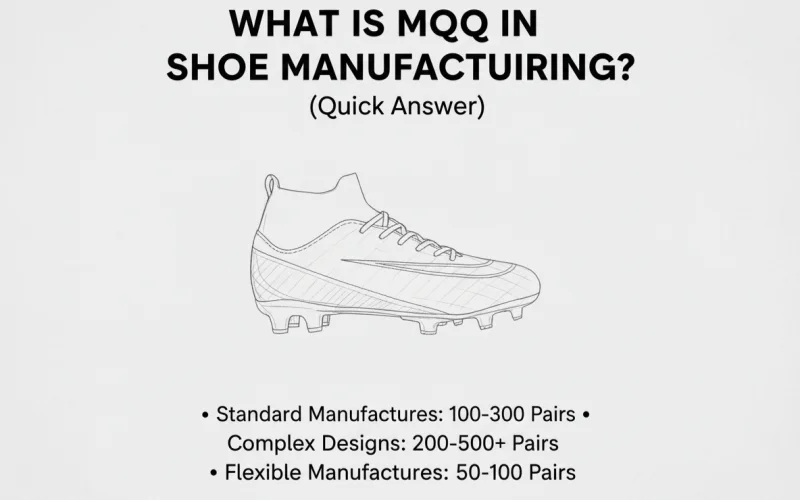
What Is MOQ in Shoe Manufacturing? (Quick Answer)

MOQ (Minimum Order Quantity) is the minimum number of units a manufacturer requires per style, color, or design to start production.

Typical MOQ ranges:

  • Standard manufacturers: 100–300 pairs per style
  • Complex designs: 200–500+ pairs
  • Flexible manufacturers: 50–100 pairs

What Is MOQ in Shoe Manufacturing.webp

Why Is MOQ So High in Shoe Manufacturing?

Understanding this is key to reducing it.

Material Procurement Requirements

Factories need to purchase materials in bulk:

  • Leather
  • Outsoles
  • Hardware

Suppliers often have their own MOQ, which directly impacts your order.

Production Setup Costs

Each new design requires:

  • Pattern making
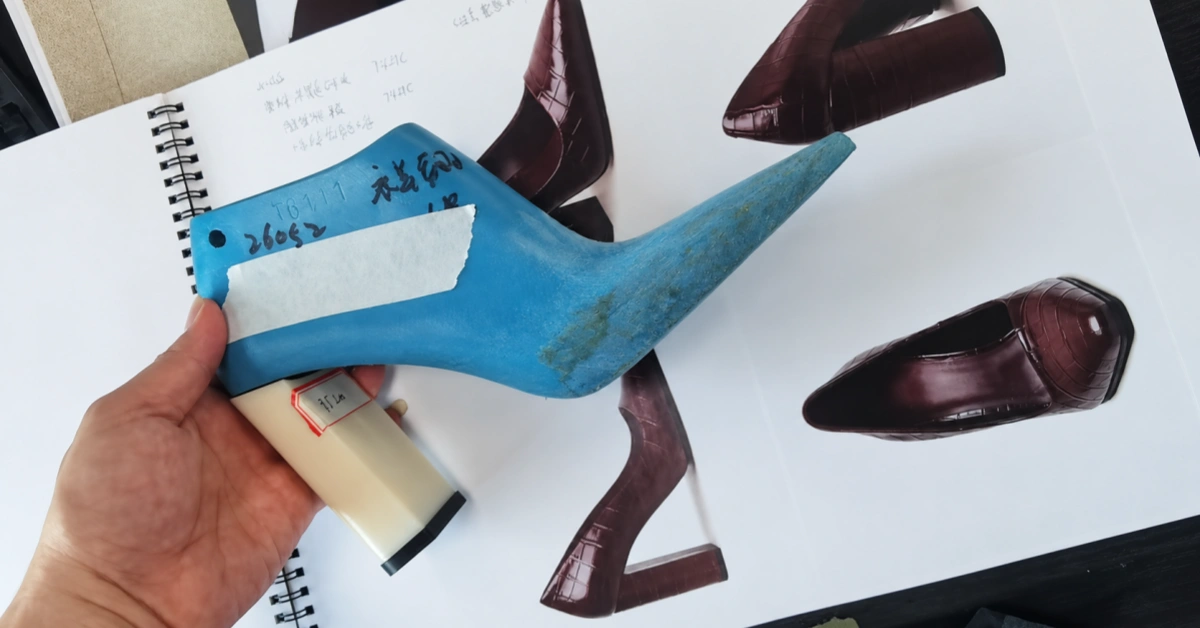
  • Last adjustment
  • Machine setup

These costs must be spread across production volume.

Labor and Efficiency

Small orders disrupt production efficiency:

  • Workers need to switch processes
  • Production lines slow down
  • Cost per unit increases

Custom Components Increase MOQ

The more customized your product is, the higher the MOQ:

  • Custom outsole molds
  • Special hardware
  • Unique materials

Risk Control for Manufacturers

Factories also manage risk:

  • Small orders = lower profit
  • Higher uncertainty
  • More communication costs

Real Case: How a Brand Reduced MOQ from 200 to 50 Pairs

launch a minimalist sneaker collection.webp

Client Background

A European startup brand wanted to launch a minimalist sneaker collection with limited initial investment.

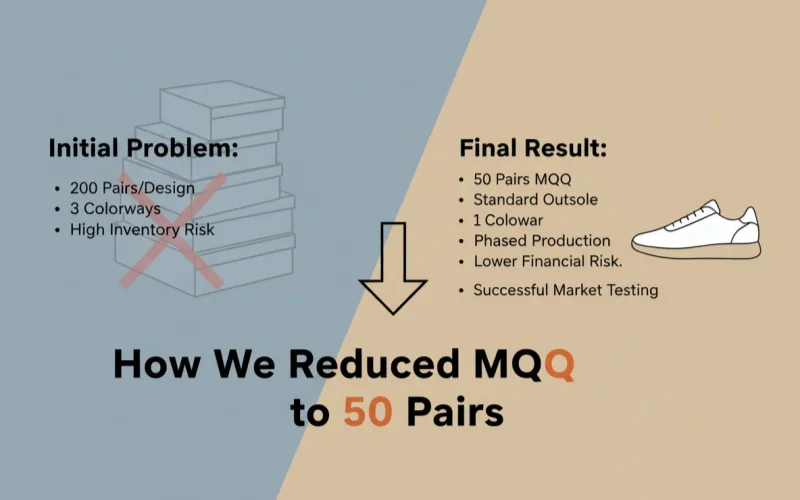
Initial Problem

Their first manufacturer required:

  • 200 pairs per design
  • 3 color variations
  • Total: 600 pairs

This exceeded their budget and created high inventory risk.

What Was Holding Them Back

  • Fully customized outsole design
  • Multiple colorways in the first order
  • No production strategy for small batch testing

How the MOQ Was Reduced

After restructuring the project, the following adjustments were made:

  • Switched to a standard outsole instead of a custom mold
  • Reduced initial color options from 3 to 1
  • Optimized material selection using available stock
  • Planned phased production instead of one large order

Final Result

  • MOQ reduced to 50 pairs
  • Faster production timeline
  • Lower financial risk
  • Successful market testing before scaling

How to Reduce MOQ for Your Shoe Project

Start with Fewer Variations

Instead of launching multiple colors:

  • Focus on 1–2 core styles
  • Expand after validation

Use Existing Components

Avoid:

  • Custom molds
  • Special hardware

Use:

  • Ready-made outsoles
  • Standard accessories

Simplify Your Design

Complexity increases MOQ:

  • Multi-layer structures
  • Special stitching
  • Unique materials

Start simple, then upgrade later.

Choose the Right Manufacturing Partner

Some manufacturers are structured for:

  • Large-scale production

Others specialize in:

  • Small batch orders
  • Startup-friendly MOQ

Choosing the right partner changes everything.

Plan in Phases

Instead of one large order:

  • Sample → small batch → scale

This reduces risk and improves decision-making.

MOQ vs Cost: What You Need to Know

Lower MOQ usually means:

  • Higher unit price
  • Lower upfront investment

Higher MOQ means:

  • Lower unit cost
  • Higher total investment

The key is balancing risk vs cost, not just chasing the lowest price.

Final Thoughts

MOQ is not just a number — it’s a reflection of:

  • Your design complexity
  • Your production strategy
  • Your manufacturing partner

Brands that understand how MOQ works can:

  • Launch faster
  • Reduce financial risk
  • Test the market more effectively

About Our Manufacturing Expertise

XINZIRAIN is a footwear and bag manufacturing brand with over 20 years of experience, serving clients across Europe and North America.

HERRAINS, as a sub-brand of XINZIRAIN, focuses on providing one-stop footwear and bag manufacturing solutions, covering the entire supply chain — from design development and material sourcing to sampling, bulk production, and global delivery.

We support flexible MOQ starting from 50 pairs, helping brands reduce risk and bring products to market faster.

FAQ

What is the typical MOQ for custom shoes?

Most manufacturers require 100–300 pairs per design, but some offer lower MOQs starting at 50 pairs.

Can MOQ be negotiated?

Yes. MOQ can often be reduced by simplifying the design, reducing variations, or using standard materials.

Why do custom designs have higher MOQs?

Because they require custom molds, materials, and setup, which increases production cost.

Is a low MOQ more expensive?

Yes, the unit price is usually higher, but the total investment is lower.

What is the best MOQ for startups?

For new brands, 50–100 pairs per design is often the most practical starting point.
XINZIRAIN Disclaimer

The content above is provided by XINZIRAIN for informational purposes. Unauthorized reproduction is prohibited. See our full disclaimer here

Table of Contents

  • 1The Hidden Barrier for New Shoe Brands
  • 2What Is MOQ in Shoe Manufacturing? (Quick Answer)
  • 3Why Is MOQ So High in Shoe Manufacturing ?
  • 3.1Material Procurement Requirements
  • 3.2Production Setup Costs
  • 3.3Labor and Efficiency
  • 3.4Custom Components Increase MOQ
  • 3.5Risk Control for Manufacturers
  • 4Real Case: How a Brand Reduced MOQ from 200 to 50 Pairs
  • 4.1Client Background
  • 4.2Initial Problem
  • 4.3What Was Holding Them Back
  • 4.4How the MOQ Was Reduced
  • 4.5Final Result
  • 5How to Reduce MOQ for Your Shoe Project
  • 5.1Start with Fewer Variations
  • 5.2Use Existing Components
  • 5.3Simplify Your Design
  • 5.4Choose the Right Manufacturing Partner
  • 5.5Plan in Phases
  • 6MOQ vs Cost: What You Need to Know
  • 7Final Thoughts
  • 8About Our Manufacturing Expertise
  • 9FAQ
  • 9.1What is the typical MOQ for custom shoes ?
  • 9.2Can MOQ be negotiated?
  • 9.3Why do custom designs have higher MOQs?
  • 9.4Is a low MOQ more expensive?
  • 9.5What is the best MOQ for startups?

Featured Blogs

Tags

#XINZIRAIN Fashion Forecast#wholesale fashion shoes#Footwear Manufacturing China#Fashion Shoe Supplier#Low MOQ Shoe#OEM & ODM services#OEM Shoe Manufacturer#Private Label Shoes

Share

Share on your :
Tina Zhang profile picture

Author:

Tina Zhang

Fashion Product Development Specialist

Specialize in custom shoe, handbag development, leather craftsmanship, and private label fashion solutions. Sharing professional insights about product design, manufacturing processes, materials, and building successful fashion brands.

Reviewed by:

Herrains Product Development Team

Featured Blogs

How to Start a Shoe Line: The Definitive Founder's Guide

How to Start a Shoe Line: The Definitive Founder's Guide

Starting a footwear brand is an exciting but highly technical journey that requires navigating sizing, structural engineering, and manufacturing. This definitive B2B playbook breaks down how to start a shoe line from initial hand-drawn sketch to first production run. Learn how to work with custom footwear manufacturers, master technical last grading, run essential stress testing on metal steel shanks, and establish a risk-mitigated, flexible 100-pair MOQ production line to protect your margins and build a profitable fashion brand.

Oct 30, 2026
Read More
The Decisive Shoe Manufacturers List for Fashion Startups: Sourcing Custom Factories in 2027

The Decisive Shoe Manufacturers List for Fashion Startups: Sourcing Custom Factories in 2027

Looking for the ultimate shoe manufacturers list to launch your footwear line? Most directories lump massive commodity plants with trading firms. This definitive guide re-structures the shoe sourcing landscape specifically for independent designer brands. Learn how to technically audit a footwear factory's lasts, shank load-bearing, and materials compliance under REACH standards, and discover how to bypass rigid MOQs to build a profitable, custom footwear collection starting from 100 pairs.

Oct 26, 2026
Read More
How to Start a Shoe Line: What to Prepare Before Contacting a Manufacturer

How to Start a Shoe Line: What to Prepare Before Contacting a Manufacturer

Learn how to start a shoe line with a clear plan for design, budgeting, sampling, and production. This guide explains what to prepare before contacting a shoe manufacturer, how to evaluate private label and custom development options, and what to confirm before your first order.

Oct 15, 2026
Read More
Custom Handbag Development: Where Hardware, Materials and Construction Change the Cost

Custom Handbag Development: Where Hardware, Materials and Construction Change the Cost

Custom handbag development costs are shaped by decisions made long before bulk production begins. From leather selection and material utilization to hardware engineering and construction details, every choice affects product quality, manufacturing efficiency, and profit margins. Explore how handbag brands can make informed development decisions, reduce unnecessary expenses, and create production-ready designs with a reliable manufacturing partner.

Oct 10, 2026
Read More
Footwear Sample Development: How to Control Revisions Before They Consume Your Margin

Footwear Sample Development: How to Control Revisions Before They Consume Your Margin

Footwear sample development involves more than turning a design into a prototype. Uncontrolled revisions, fit adjustments, material changes, and poor communication can increase costs and delay production. Discover how footwear brands can manage sampling, improve development accuracy, and protect profit margins through structured collaboration with an experienced custom shoe manufacturer.

Oct 10, 2026
Read More
From Pre-Order to Repeat Orders: A Footwear & Handbag Production Planning Guide for Brands

From Pre-Order to Repeat Orders: A Footwear & Handbag Production Planning Guide for Brands

Learn how footwear and handbag brands use pre-orders, small-batch production, inventory planning and repeat orders to reduce risk, improve profitability and build a more sustainable path from first production to long-term growth.

Oct 04, 2026
Read More